
The fundamental reason for that is habitat. About 68 percent of Idaho consists of rugged mountains and high deserts managed for the public by federal and state agencies. Idaho still has room for big animals and for the people who pursue them.
Elk are found in varying densities in nearly every county in Idaho, from the Canadian border to the southern end of the state. Hunter success rates have held consistently for decades around 20 percent statewide though statistics for individual hunts show wide variation. Idaho offers hunts ranging from controlled (draw) hunts with success rates approaching 100 percent to general (over the counter) hunts to archery and muzzleloader elk hunts with success usually less than 10 percent.
Mule deer have always been a staple for Idaho hunters and nonresidents alike. All western states have seen a long, slow slide from peak mule deer numbers, a trend many biologists suspect is tied to subtle alterations in habitat. The Idaho Fish and Game Commission has committed a major effort through its Mule Deer Initiative to halting that decline. Recent hunter results in some areas seem to validate the effort. Hunters continue to place Idaho mule deer in the record books.
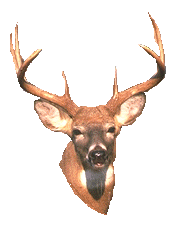
Whitetail deer have traditionally been north Idaho's secret. So many other states are known for whitetail hunting that Idaho's outstanding opportunities have belonged to the locals. These herds seem to be stable north of the Salmon River and gradually encroach further south, even as far as the Boise River corridor.
Pronghorn numbers jumped in the late 1980s, crashed after the infamous winter of 1988-89, and have since stabilized. Southeast Idaho holds the largest portion of Idaho antelope but they are doing well in the high desert of Owyhee County. Idaho cannot compete with Wyoming in antelope numbers or entries in the record books but our big-bodied pronghorns delight those lucky enough to draw a permit.
Bighorn Sheep come in two varieties in Idaho, one of the few places in the country where Rocky Mountain and California bighorns are found in huntable numbers. A vigorous program of trapping and transplanting has brought bighorns back to most of their historic range in Idaho. California types inhabit the rugged plateaus and canyonlands of the Owyhee County desert. Rocky Mountain sheep occupy the rest of the bighorn territory. Our Rocky Mountain bighorns have taken a hit in recent years from respiratory diseases and are now in a rebuilding mode in some important areas, a situation keeping draw permit numbers down until herds come back and young rams mature.
Mountain goats maintain a fairly stable to slightly declining population in the most rugged parts of Idaho. Goats are carefully managed, hunted quite conservatively, and are transplanted where possible to try to fill their historic ranges.
Moose provide one of the brightest spots in game management in Idaho. A long-term program to reintroduce them into historic range has paid off; moose are found in most of the habitats that can sustain them throughout the length of the state. Moose numbers and hunting permits remain fairly stable.
Black bear hunting in Idaho still allows for use of bait, hounds and spring as well as fall seasons. Bear numbers remain stable despite hunting pressure. Bears inhabit all except the most urbanized and intensively farmed areas but are most common in the central mountains and north Idaho.
Mountain lions may be pursued or hunted with hounds as well as other methods of take. Populations are maintained with strict control over the taking of female cats. Like bears, they are found in most of Idaho wherever development is not too dense. Also like bears, their numbers are stable or slightly increasing.
Gray wolves are big game animals in Idaho. The first regulated wolf hunt in Idaho history drew more than 31,000 tag buyers and ended with 188 wolves reported taken in 2009 and the first three months of 2010. Legal action blocked authorized hunting in the rest of 2010 but hunting was approved again in 2011 under more liberal rules than those of 2009. Wolves have been see in most Idaho counties but are most common in the mountainous center of the state and in northern forests. Estimated numbers of wolves before the 2011 hunting season were above 1,000 statewide.
Check out the latest Big Game Update.
 The online magazine choice.
A quarterly magazine designed to bring the Idaho hunter the most current information.